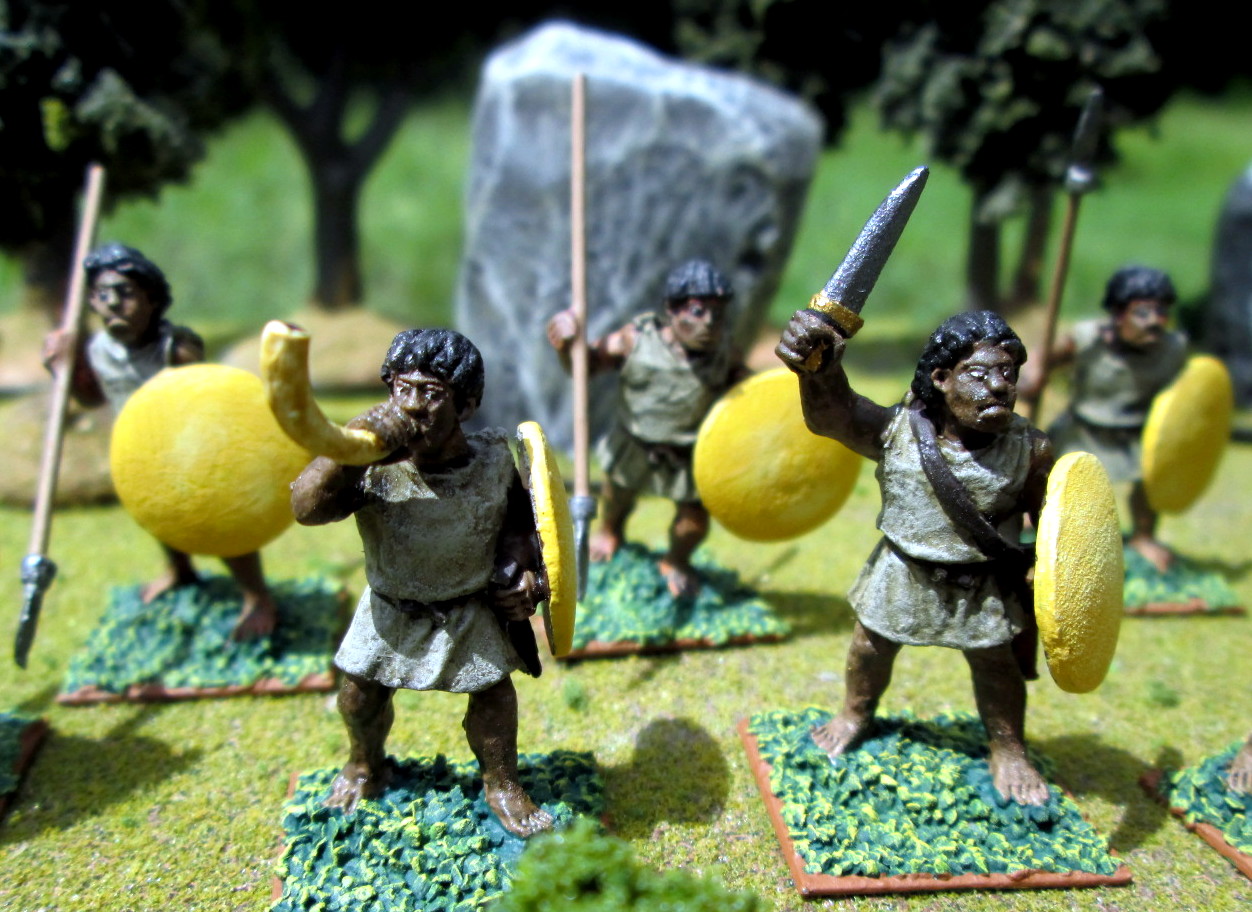
I painted eight of the spearmen in this unit a couple of years ago. Just this past weekend I finished the four command figures to match this unit. All of the figures are by Crusader miniatures. I am trying to make sure that every one of my units in the Carthaginian army have at least a leader figure. So now this unit of skirmishers is twelve men strong. Enjoy!
Monday, August 22, 2016
Saturday, August 20, 2016
Numidian Light Horse
Earlier this month I completed this unit of Numidian Light Horse. The figures are from Crusader Miniatures. I am nearing "completion" of my Carthaginian army! It is pretty exciting to see that particular lead pile start to dwindle down. I like how these guys turned out. The skin tone is perhaps a shade darker than I intended, but it's okay with me. I am planning to add command figures to every unit in this army so that I can use them for playing "War & Conquest". Enjoy the photos, there will be more soon.
Saturday, July 30, 2016
Punic Cavalry
Recently I have been working on my Carthaginian army. I started collecting Romans and Carthaginians back in 1996. In 1999 I published the Punic War scenario book "Hannibal Ad Portas". Back in those days all of my figures were 25mm Ral Partha miniatures. By today's standards those figures are puny. They look like little boys. So several years ago I started re-doing both of those armies using 28mm figures that look awesome! The Punic army is nearly complete, this past month I finished my Balearic slingers and then started and finished this unit of Carthaginian Heavy Cavalry from Crusader Miniatures. Enough talk, here is the proof!
Saturday, June 11, 2016
Wars of the Roses retinue archers
Here are a few photos of a small group of archers I just finished. The minis are from Front Rank. My 13 year old son is also painting some of these figures and I hope to post some of his work soon! These guys are not painted to be any specific lord's troops, they are just intended to invoke the period.
Wednesday, May 4, 2016
More Soviets!!!
This group got painted considerably faster than the last batch. Here are a few photos of them. Not the best photos, but... at least they are posted.
| Maxim HMG |
| Maxim HMG |
| ATR team (PTRD-41) |
| ATR team (PTRD-41) |
| Two LMG teams and two officers |
| Two LMG teams and two officers |
So there you go! After painting 40 Russians in a row I am going to take a little break from the eastern front. Next project is a large group of US Army rifles plus some support.
Friday, March 25, 2016
WWII Soviets: Finished
I know, it's been what a year and a half since my last post about these guys? So what happened? Lots of stuff. Work, family, chickens, turkeys, pigs, travel, home repairs,...you name it. But... Finally... I did complete these guys, and here is the evidence.
Since the last post I added eyes and hair. For eyes, I paint the eye socket white and then using some dark brown paint I put a tiny spot in one corner of the eye socket. For the other eye, I match the direction the figure is now looking - so both eyes will look left or right. If you put the spot right in the center you get a bug-eyed zombie kind of look. For hair I generally use brown ink and add one or two glazes of ink.
Next, I use bronze paint to pick out all of the buttons and buckles. Then use gun metal silver to pick out all of the rifle hardware and other small metal bits on the figure.
That just leaves the base. I paint the base dark brown and dry brush it with a medium brown and then a mudstone-gray very lightly. lastly I paint the edge of the base a solid flat color to denote which army the figure belongs to. In this case I use a Squad Leader Russian brown color. And there you go! Komplejt!
Since the last post I added eyes and hair. For eyes, I paint the eye socket white and then using some dark brown paint I put a tiny spot in one corner of the eye socket. For the other eye, I match the direction the figure is now looking - so both eyes will look left or right. If you put the spot right in the center you get a bug-eyed zombie kind of look. For hair I generally use brown ink and add one or two glazes of ink.
Next, I use bronze paint to pick out all of the buttons and buckles. Then use gun metal silver to pick out all of the rifle hardware and other small metal bits on the figure.
That just leaves the base. I paint the base dark brown and dry brush it with a medium brown and then a mudstone-gray very lightly. lastly I paint the edge of the base a solid flat color to denote which army the figure belongs to. In this case I use a Squad Leader Russian brown color. And there you go! Komplejt!
Wednesday, November 19, 2014
Homestead Analysis & 3-Wide Design Theory
On Sunday the 2014 NASCAR championship race was held at Homestead-Miami
Speedway. As the race unfolded, the four drivers with championship
hopes were all running in the top five positions. But the defining
moment of the race was the caution period with 20 laps to go. When the
yellow flag was displayed, Harvick was in 3rd, Hamlin was 4th, Newman
5th and Logano was in 6th place. The four pit crew chiefs then made
some very interesting choices that ultimately decided the outcome of the
race and the season championship.
The race leader, Jeff Gordon stayed out on the track, and in a gutsy call, Hamlin’s crew chief Darian Grubb also decided to not make a pit stop. This put Hamlin in second place with older tires. Kevin Harvick’s crew chief made the standard call for four fresh tires. Ryan Newman’s team opted to change only the two right side tires thus having a quicker pit stop than Harvick. Meanwhile disaster befell Joey Logano when his car slipped off of the jack in the pit stall. By the time his team struggled to get the car back up on the jack, 49 seconds had ticked away, and his championship hopes had also expired.
When the cars lined up for the restart with 15 laps to go, Gordon was 1st, followed by Hamlin in 2nd, both of them on older tires. Newman lined up 3rd with two fresh tires, and Harvick was in 12th with four fresh tires. The race was at this moment a question of whether Hamlin could hold off Newman for the remaining laps, and if there was enough time for Harvick to advance from 12th on his new tires. As it worked out, two more caution flags doomed Hamlin’s chances, and gave Harvick the opportunity to advance to the lead. Newman, with his two fresh tires, never had quite enough speed to seriously challenge Harvick for first place.
In my opinion, the pit strategy calls on the lap 20 caution were fascinating, and this is precisely what I have tried to capture in designing 3-Wide. Most racing boardgames focus on the tactical aspect of racing – gear selection, cornering, and overtaking. 3-Wide covers the tactical actions through card play, you can play cards for your drivers to allow them to make a pass, draft with the pack, bump and run under your rivals, and other tactics. But I wanted the design to also reflect the decisions that the crew chief makes. When do you pit? Do you want four tires? two tires? fuel only? Should I take the time to try to fix damage on the car, or do I just try to gut it out with an ill-handling race car? These are the strategic decisions that are every bit as important as the tactical maneuvers. Maybe even more important.
An big part of 3-Wide is the ‘racing’ phase. During the racing phase cars roll custom dice based on their current level of tire wear. Each tire can be black, green, yellow or red – black is a new tire, and red is extremely worn. So if a car has two black, one green and one yellow tire, the car will roll two black, one green and one yellow die. The results will determine how far the car is moved on the track, and whether or not the car is risking a blown tire incident. (There is also the possibility of choosing a slower die result and saving fuel.)
So in summary, this tire/racing mechanic determines how fast you go, and is a result of your pit stop choices. I thought that yesterdays NASCAR finale was a thrilling race, and I felt that it confirmed my design decisions in making 3-Wide.
And what about Joey Logano? He had some horrible luck when his car fell off the jack in the pits. In the design of 3-Wide I’ve chosen to avoid hitting players with this kind of random-bad-luck event. You can’t have a pit stop disaster like Logano did yesterday. And although you can find yourself caught up in an accident through no real fault of your own, all 3-Wide racing incidents are a result of someone, somewhere, pushing the limit of their car and their luck. I think this is the right choice for a racing game.
The race leader, Jeff Gordon stayed out on the track, and in a gutsy call, Hamlin’s crew chief Darian Grubb also decided to not make a pit stop. This put Hamlin in second place with older tires. Kevin Harvick’s crew chief made the standard call for four fresh tires. Ryan Newman’s team opted to change only the two right side tires thus having a quicker pit stop than Harvick. Meanwhile disaster befell Joey Logano when his car slipped off of the jack in the pit stall. By the time his team struggled to get the car back up on the jack, 49 seconds had ticked away, and his championship hopes had also expired.
When the cars lined up for the restart with 15 laps to go, Gordon was 1st, followed by Hamlin in 2nd, both of them on older tires. Newman lined up 3rd with two fresh tires, and Harvick was in 12th with four fresh tires. The race was at this moment a question of whether Hamlin could hold off Newman for the remaining laps, and if there was enough time for Harvick to advance from 12th on his new tires. As it worked out, two more caution flags doomed Hamlin’s chances, and gave Harvick the opportunity to advance to the lead. Newman, with his two fresh tires, never had quite enough speed to seriously challenge Harvick for first place.
In my opinion, the pit strategy calls on the lap 20 caution were fascinating, and this is precisely what I have tried to capture in designing 3-Wide. Most racing boardgames focus on the tactical aspect of racing – gear selection, cornering, and overtaking. 3-Wide covers the tactical actions through card play, you can play cards for your drivers to allow them to make a pass, draft with the pack, bump and run under your rivals, and other tactics. But I wanted the design to also reflect the decisions that the crew chief makes. When do you pit? Do you want four tires? two tires? fuel only? Should I take the time to try to fix damage on the car, or do I just try to gut it out with an ill-handling race car? These are the strategic decisions that are every bit as important as the tactical maneuvers. Maybe even more important.
An big part of 3-Wide is the ‘racing’ phase. During the racing phase cars roll custom dice based on their current level of tire wear. Each tire can be black, green, yellow or red – black is a new tire, and red is extremely worn. So if a car has two black, one green and one yellow tire, the car will roll two black, one green and one yellow die. The results will determine how far the car is moved on the track, and whether or not the car is risking a blown tire incident. (There is also the possibility of choosing a slower die result and saving fuel.)
So in summary, this tire/racing mechanic determines how fast you go, and is a result of your pit stop choices. I thought that yesterdays NASCAR finale was a thrilling race, and I felt that it confirmed my design decisions in making 3-Wide.
And what about Joey Logano? He had some horrible luck when his car fell off the jack in the pits. In the design of 3-Wide I’ve chosen to avoid hitting players with this kind of random-bad-luck event. You can’t have a pit stop disaster like Logano did yesterday. And although you can find yourself caught up in an accident through no real fault of your own, all 3-Wide racing incidents are a result of someone, somewhere, pushing the limit of their car and their luck. I think this is the right choice for a racing game.
Subscribe to:
Posts (Atom)